

Streamlining Endangered Species Reviews

Goal 17 aims to increase the efficiency and effectiveness of the Natural Diversity Data Base (NDDB) review process for all stakeholders. NDDB review is a core component of DEEP’s approach to ensuring state permitted activities do not produce adverse effects for rare and imperiled plant and animal species. The complexity of NDDB review and reliance on external parties to complete necessary steps in the process can, at times, result in extended review timelines. This goal seeks to identify additional resources and process improvements that may reduce review timelines and help external parties better understand the process. Background on this goal is presented in DEEP’s 20BY26, Setting the Target: CT DEEP 2026 Goals (February 2024).
 Latest Progress (as of Winter 2025)
DEEP retained a communications consultant to review our published NDDB guidance and instructions, to conduct interviews with various program users, and to survey stakeholders.
DEEP is also exploring refinements to the screening map to better reflect on-the-ground conservation potential and direct biologist review.
DEEP created the below flowchart to provide increased predictability and transparency on the NDDB review process and to capture at a high level the following steps:
- Applicant submittal of an NDDB review request through the eNDDB portal.
- If no impacts or if standardized Best Management Practices are appropriate, the portal provides an automated response to the applicant, and no further review is required. Otherwise, the portal provides a response indicating biologist review is required, and the application is assigned to a biologist for review.
- The assigned biologist conducts a “sufficiency review” to determine if the application is complete and contains sufficient information to allow review. If insufficient, the biologist will contact the applicant. If sufficient, the biologist will commence a technical review.
- The target timeline for completion of technical review is 10-12 weeks, although most reviews take under 30 days. The biologist then issues a final NDDB determination letter to the applicant, detailing (1) any anticipated impacts to rare species on the project site, (2) prescribed best management practices for minimizing impacts, and (3) requirements for mitigating unavoidable impacts.
- During technical review, the biologist may determine that additional information is required and will issue a “Request for Additional Information” letter to the applicant. Once the applicant submits the required information and the biologist determines it is sufficient, the application will return to the technical review phase. Requests for additional information may add substantial time to the overall timeline (6-12 months is a reasonable expectation).
NDDB Workflow
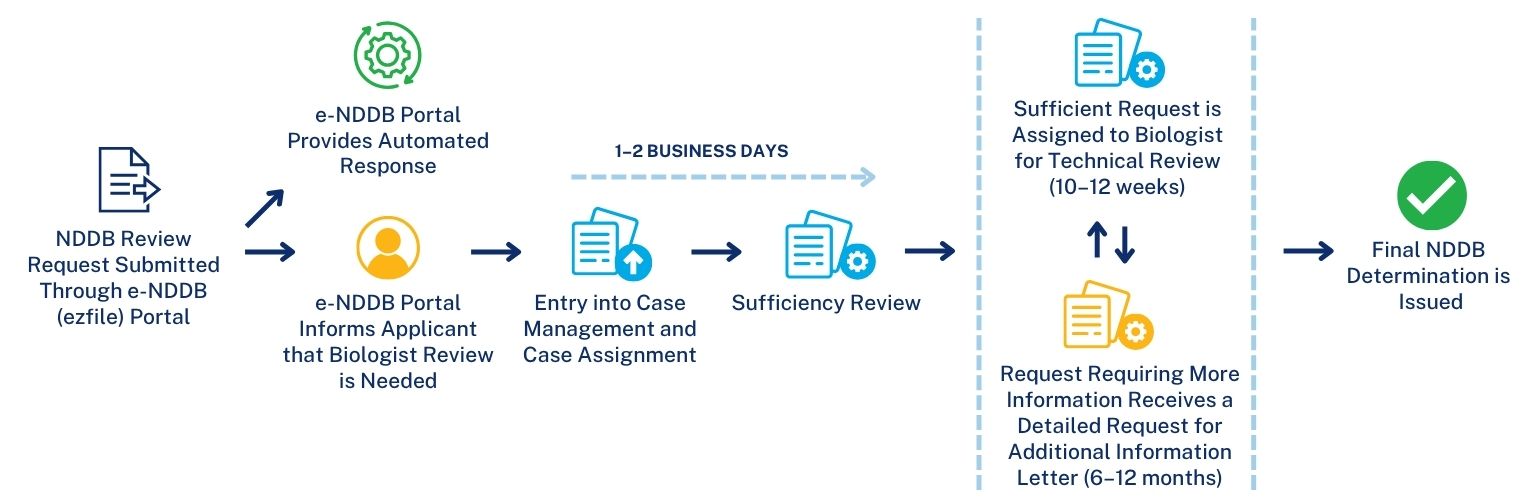

In Q1 2025, DEEP’s NDDB program received 348 requests. Many were related to aquatic invasive species treatment, which increases the baseline number of requests we usually receive in a quarter. DEEP provided 134 automated responses (i.e., response from the automated eNDDB portal indicating that there are no anticipated project impacts to rare species and therefore no further review is required), and 214 required further biologist review. DEEP issued a total of 213 biologist determinations this quarter.
As shown in the chart below, DEEP completed the majority of biologist reviews within 35 days in 2024 – much faster than the target limit of 10-12 weeks.
 Up Next
DEEP will begin to implement section 3 of Governor’s Bill HB 6868, which directs DEEP to prepare a report that evaluates potential improvements to environmental review undertaken pursuant to the state Endangered Species Act. This review includes an assessment of similar environmental review programs in other states, developing criteria for third party consultant qualifications, and a prioritized list of resources needed to enhance efficiency and predictability for the NDDB program. Meanwhile, DEEP’s consultant will be conducting interviews with and surveying stakeholders. The consultant will then provide recommendations based on their findings.
GOAL 17 PROGRESS FROM PREVIOUS QUARTERS
Fall 2024
DEEP developed a scope of work for an environmental communication specialist to review current communication tools and web content and provide suggestions for improvements and enhancements to existing messaging and instructions. Program botanists continued to work on plant circumscriptions to inform mapping and streamline botanical reviews. Evaluation of NDDB review requests submitted over the last two years (November 2022 – January 2025) shows that approximately 1,200 requests are received annually for biologist review and that approximately the same number of Site Assessment Inquires are submitted and receive an automatic response.
SPATIAL DISTRIBUTION OF NDDB REVIEW REQUESTS SUBMITTED BETWEEN NOVEMBER 2022 AND JANUARY 14, 2025
(approximately 2,500 requests, or approximately 1,200 annually).

Summer 2024
DEEP assembled a goal team to lead this process improvement effort, and the team began identifying capacity- and process-related factors affecting the efficiency of programmatic review. For example, aquatic pesticide reviews are challenging to complete on a short timeframe without an aquatic botanist on staff due to the research involved. Having a dedicated NDDB email enables direct communication with the public, but managing the high volume of emails is challenging.
Winter 2024
This stakeholder-suggested goal was launched in August 2024.
Content last updated July 2025